Introduction
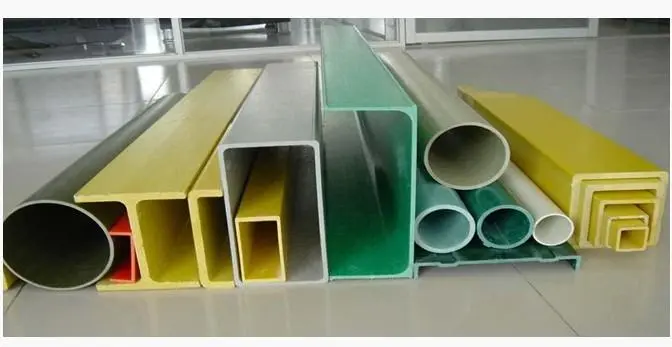
FRP pultrusion profiles have revolutionized structural engineering by offering a lightweight, corrosion-resistant alternative to traditional steel and aluminum. This comprehensive guide explores everything you need to know about pultruded FRP profiles — from the manufacturing process that creates them to the diverse range of shapes available, their key advantages over metals, and the industries that rely on them every day.
Whether you are a structural engineer evaluating FRP for a new project, a procurement manager comparing material costs, or a designer looking for non-corrosive structural members, this guide will equip you with the technical knowledge to make informed decisions. We cover standard sizes, custom manufacturing capabilities, design principles, and real-world applications of pultruded FRP sections across multiple sectors.
What Is the Pultrusion Process for FRP Profiles?
The pultrusion process is a continuous, automated manufacturing method used to produce high-strength pultruded composite profiles with a constant cross-section. Similar to extrusion in metals but using reinforced polymer composites, pultrusion pulls fiber reinforcements through a resin bath and then through a heated die that cures the material into its final shape. The result is a structural profile with exceptional strength-to-weight ratio, dimensional consistency, and corrosion resistance that makes these pultruded FRP profiles ideal for demanding environments.
This process enables the production of pultruded sections in virtually any shape, from simple solid rods to complex multi-cavity structural sections. Unlike metals that require secondary forming or welding, pultruded profiles emerge from the production line ready for installation, with precisely controlled fiber orientation that optimizes mechanical properties in the load-bearing direction.
Step-by-Step Pultrusion Process
The manufacturing of frp pultruded sections follows a carefully controlled sequence of steps that ensure consistent quality and mechanical performance:
- Reinforcement Creel: Continuous fiber rovings (typically E-glass or S-glass), continuous strand mats, and surfacing veils are mounted on a creel system and fed into the process under controlled tension.
- Resin Impregnation: The dry reinforcements pass through a resin bath containing a precisely formulated mixture of thermosetting resin (usually polyester, vinyl ester, or epoxy), fillers, pigments, UV stabilizers, and flame retardant additives. The fibers are fully saturated through a combination of bath immersion and wiper dies.
- Pre-forming: The resin-wetted fibers pass through a series of pre-form guides that gradually shape the material into the desired cross-section geometry before entering the heated die.
- Curing Die: The shaped material enters a heated steel die where controlled temperature (typically 120-180°C) triggers the cross-linking reaction that cures the thermosetting resin. The die maintains precise dimensional tolerances and surface finish.
- Pullers: Caterpillar-type or reciprocating pullers continuously draw the cured profile through the line at a steady speed, typically 0.3 to 2 meters per minute depending on profile complexity and wall thickness.
- Cutting: An automated cut-off saw, synchronized with the line speed, cuts the continuous profile to the specified lengths, typically 6 or 12 meters standard, or custom lengths as required.
This continuous process minimizes labor cost and ensures every meter of profile has identical properties, making these profiles highly predictable for structural design.
Materials Used in FRP Pultrusion Profiles
The performance of FRP profiles depends heavily on the raw materials selected. Three primary components define the final properties:
Fiber Reinforcements
- E-Glass: The most widely used reinforcement, offering excellent strength at economical cost. E-glass fibers provide tensile strength of 3,400 MPa and modulus of 72 GPa.
- S-Glass: Higher strength and stiffness than E-glass, used when superior mechanical performance is required at moderate additional cost.
- Carbon Fiber: Used in specialized frp pultruded sections requiring maximum stiffness and fatigue resistance, with modulus values exceeding 200 GPa.
- Aramid (Kevlar): Selected for impact resistance and cut-through resistance in demanding applications.
Resin Systems
- Polyester Resin: The most economical choice for general-purpose profiles. Good mechanical properties and UV resistance for standard indoor and outdoor applications.
- Vinyl Ester Resin: Superior corrosion resistance compared to polyester, ideal for chemical processing plants, water treatment facilities, and marine environments. Also provides better fatigue resistance.
- Epoxy Resin: Highest mechanical performance and adhesion properties. Used in aerospace-grade and high-stress structural components where maximum strength is required.
- Phenolic Resin: Exceptional fire performance with low smoke emission, mandatory for mining, tunnel, and mass transit applications with strict fire codes.
Additives and Fillers
- UV Stabilizers: Prevent surface degradation and color fading in outdoor installations.
- Flame Retardants: Achieve specified fire ratings (UL 94, ASTM E84) for building code compliance.
- Pigments: Integral coloring throughout the profile thickness eliminates the need for painting.
- Fillers: Calcium carbonate, alumina trihydrate, and other mineral fillers improve surface finish and reduce cost while maintaining structural properties.
The combination of these materials allows manufacturers to tailor pultruded FRP sections for specific environments — from highly corrosive chemical plants to lightweight aerospace structures.
Types of Pultruded FRP Profiles
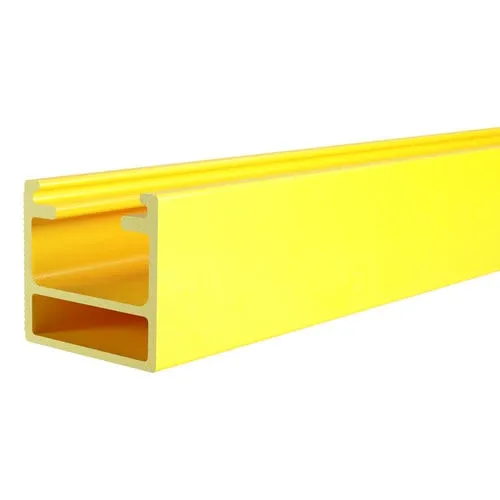
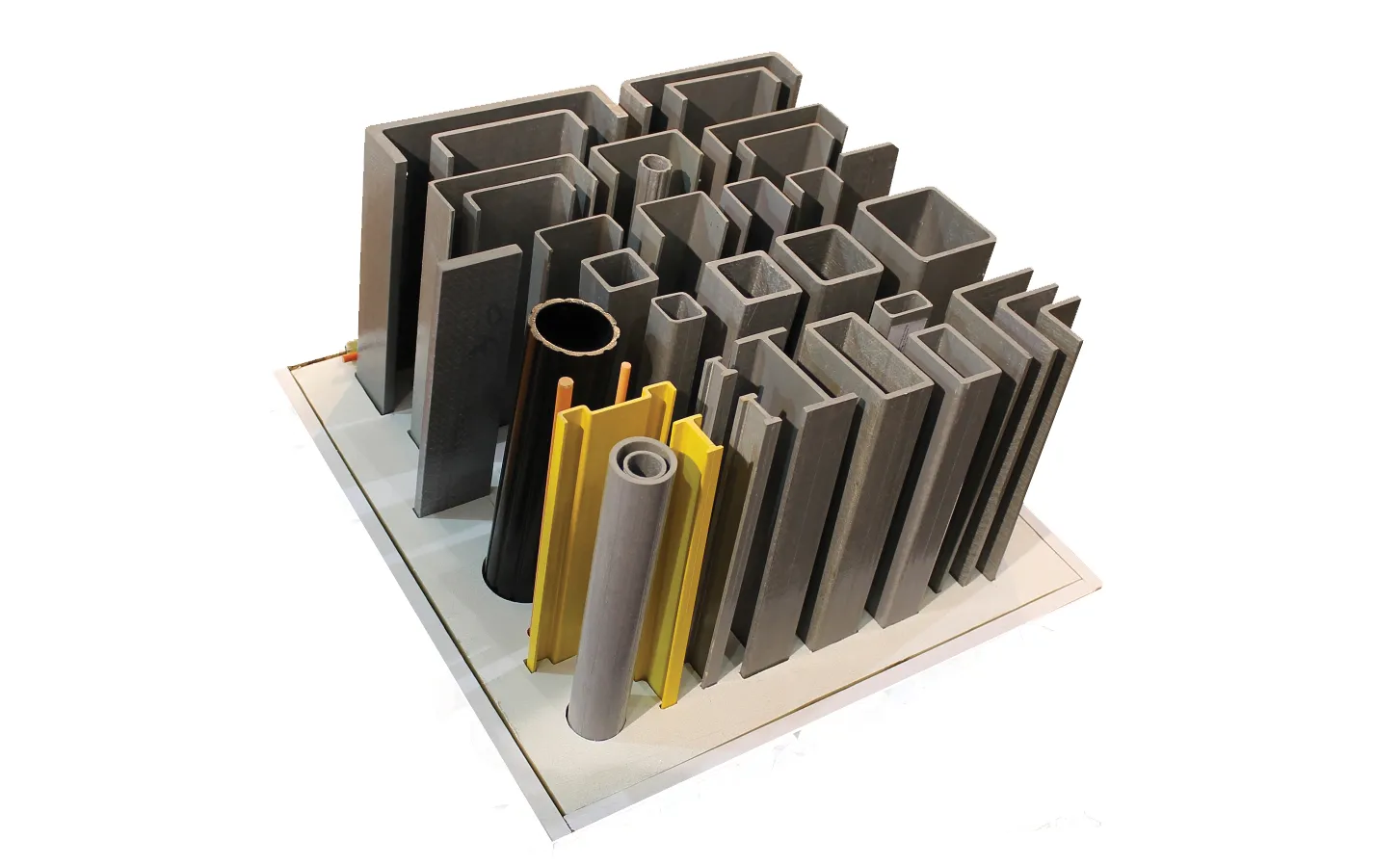
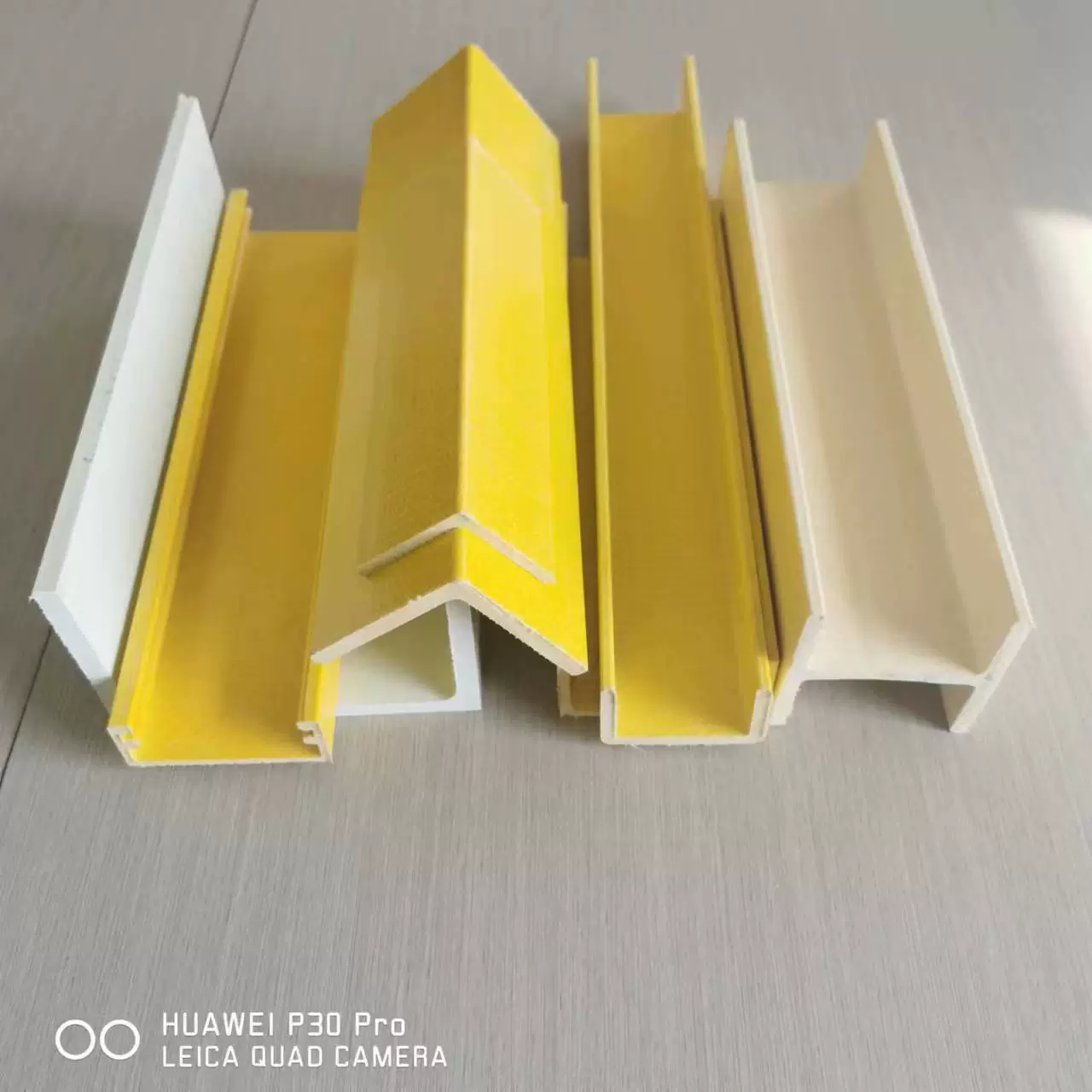
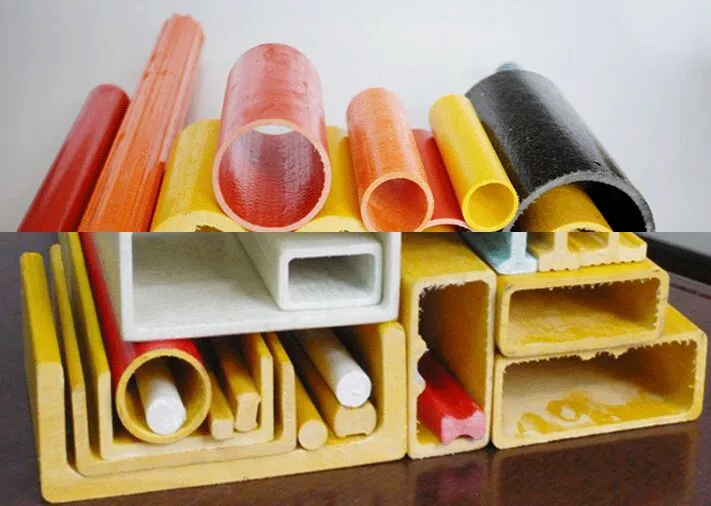
These pultruded profiles are manufactured in a wide range of standard structural shapes that mirror traditional steel sections, plus custom geometries tailored to specific applications. The most common types of pultruded FRP profiles include beams, channels, angles, and tubular sections, each designed to serve distinct structural functions. Understanding the characteristics of each shape is essential for selecting the right profile for your project.
What are pultruded FRP profiles for structure? These profiles serve as primary and secondary structural members in load-bearing applications, offering predictable mechanical properties that engineers can design with using established standards. When used for structural purposes, pultruded FRP profiles function as beams, columns, bracing, and framing elements — just like steel — but with the added benefits of corrosion resistance, electrical insulation, and significant weight reduction.
The versatility of the pultrusion process means that virtually any constant cross-section can be produced, from simple flat bars to complex multi-web box beams. Below we examine the most widely used pultruded FRP profiles and their typical applications.
FRP I-Beams and Wide Flange Beams
FRP I-beams and wide flange beams (sometimes called H-beams) are among the most popular frp pultruded sections for structural applications. These profiles provide excellent bending strength and stiffness relative to their weight, making them ideal for beams, girders, and columns in lightweight structures.
Key characteristics:
- Parallel flanges with a vertical web create high section modulus for bending resistance
- Wide flange beams offer greater lateral stability compared to standard I-beams
- Available in depths from 100 mm to 600 mm, with flange widths proportional to depth
- Commonly used as primary structural members in walkways, platforms, and building frames
- Can be combined with gratings and handrails for complete FRP structural systems
Typical applications include pedestrian bridges, mezzanine flooring support, cable tray supports, and offshore platform structures where weight savings and corrosion resistance deliver significant lifecycle value.
FRP Channels and C-Sections
FRP channel sections and C-sections provide excellent structural efficiency for applications requiring high strength in a single plane. The distinctive C-shaped cross-section offers a flat mounting surface with integral stiffening flanges.
Key characteristics:
- Widely used as edge beams, stiffeners, and framing members in structural assemblies
- Available in equal-leg and unequal-leg configurations
- Typical depths range from 50 mm to 300 mm with flange widths of 25-75 mm
- Often paired with FRP angles to create moment-resisting connections
- Excellent for equipment support frames and skid bases in corrosive environments
FRP channels are particularly popular in the water treatment industry, where they replace coated steel channels in filter beds, clarifier walkways, and chemical feed systems. Their inherent corrosion resistance eliminates the recurring cost of repainting and replacing rusted steel sections.
FRP Angles and L-Shapes
FRP angle sections (L-shapes) are the most versatile of all pultruded FRP profiles, serving as connection elements, bracing members, and edge protection across countless structural assemblies.
Key characteristics:
- Available in equal-leg angles (same leg length) and unequal-leg angles
- Leg lengths typically range from 25 mm × 25 mm up to 150 mm × 150 mm
- Wall thicknesses from 3 mm to 12 mm depending on structural requirements
- Commonly used as corner guards, frame bracing, ladder rails, and stiffeners
- Excellent for bolted connections to other FRP sections
FRP angles shine in applications requiring frequent disassembly and reassembly, such as removable handrails, modular platform systems, and adjustable pipe supports. Their light weight — approximately one-quarter that of equivalent steel angles — drastically reduces installation labor costs and eliminates the need for heavy lifting equipment.
FRP Square and Round Tubes
FRP tubular profiles include square tubes, round tubes, and rectangular hollow sections — each offering unique structural advantages for applications requiring torsional strength and clean aesthetics.
Square Tubes:
- Equal side dimensions from 25 mm × 25 mm to 200 mm × 200 mm
- Wall thicknesses from 3 mm to 12 mm
- Excellent for columns, handrail posts, and space frame structures
- Clean, flush appearance with consistent outer dimensions
Round Tubes:
- Outside diameters from 20 mm to 300 mm
- Commonly used as rollers, pipes, and structural columns in corrosive environments
- Smooth surface ideal for applications requiring low friction or fluid flow
- Often selected for antenna masts and utility poles due to non-conductive properties
Rectangular Hollow Sections:
- Available in a wide range of aspect ratios for specific bending requirements
- Preferred for bridge railings, guardrails, and architectural structures
- Greater bending stiffness in the strong axis compared to square tubes of equivalent material weight
Tubular frp pultruded sections are particularly valued in architectural and infrastructure projects where both structural performance and visual appeal are important. Their hollow cross-section efficiently resists torsion while minimizing material usage and weight.
Advantages of FRP Pultrusion Profiles Over Metal
When comparing FRP pultruded sections to traditional metal sections, the differences are striking across multiple performance criteria. Here is a detailed comparison of the key advantages:
| Property | FRP Pultrusion Profiles | Structural Steel | Aluminum |
|---|---|---|---|
| Density | 1.6-2.0 g/cm³ | 7.85 g/cm³ | 2.7 g/cm³ |
| Tensile Strength | 200-400 MPa | 250-400 MPa | 70-300 MPa |
| Corrosion Resistance | Excellent (inherent) | Poor (requires coating) | Good (limited in chlorides) |
| Electrical Conductivity | Non-conductive | Conductive | Conductive |
| Thermal Conductivity | Very Low (0.3-0.5 W/mK) | High (50 W/mK) | High (200 W/mK) |
| Fatigue Life | Excellent | Good (with design) | Moderate |
| Weight (relative) | 1× | 4× | 1.5× |
The most significant advantages of pultruded composites over metal include:
- Corrosion Resistance: FRP does not rust, rot, or corrode. This eliminates the need for protective coatings, galvanizing, or cathodic protection systems, resulting in dramatically lower maintenance costs over the service life.
- Weight Reduction: Pultruded FRP profiles weigh approximately 75% less than steel and 30% less than aluminum, enabling lighter support structures, easier handling, and reduced transportation costs.
- Electrical Insulation: FRP is electrically non-conductive and non-magnetic, making it the material of choice for electrical substation structures, antenna supports, and rail infrastructure.
- Thermal Performance: Low thermal conductivity eliminates condensation problems and reduces heat transfer in building envelopes.
- Design Freedom: The pultrusion process can produce complex multi-cavity shapes that would be expensive or impossible to fabricate in metal, consolidating multiple parts into a single FRP profile.
- Low Lifecycle Cost: Although the initial material cost may be higher than carbon steel, the total installed cost is often competitive due to lighter foundations, faster installation, and zero maintenance over decades of service.
These advantages make these profiles the preferred choice in environments where metal would fail prematurely due to corrosion, chemical attack, or moisture exposure.
Standard Sizes and Custom Manufacturing of FRP Profiles
One of the most common questions engineers ask is: what are the standard sizes for these profiles? The answer depends on the manufacturer and the shape, but the industry has developed a range of standard dimensions that are readily available from most producers.
Standard Size Ranges by Profile Type:
- I-Beams: 100 × 50 mm up to 600 × 200 mm, with web thicknesses from 6 mm to 18 mm
- Channels: 50 × 25 mm to 300 × 90 mm, with thicknesses from 4 mm to 12 mm
- Angles: 25 × 25 × 3 mm to 150 × 150 × 12 mm (equal leg); unequal leg sizes also available
- Square Tubes: 25 × 25 mm to 200 × 200 mm, wall thickness 3-12 mm
- Round Tubes: 20 mm OD to 300 mm OD, wall thickness 2-12 mm
- Flat Bars: Widths 25-300 mm, thicknesses 3-50 mm
- Sheet/Plate: Thicknesses 1.5-50 mm, widths up to 1200 mm
Can FRP pultrusion profiles be custom made? Absolutely. While standard sizes are available off-the-shelf, custom profiles are one of the key advantages of the pultrusion process. Custom tooling (a steel die) can be manufactured for virtually any cross-sectional geometry, provided it has a constant cross-section. Typical die costs range from $2,000 to $15,000 depending on complexity, and minimum production quantities generally start at 500-1000 linear meters per order.
Custom profile capabilities include:
- Unique geometries combining multiple structural features in one profile
- Specific fiber architecture to optimize strength in particular directions
- Custom colors, surface textures, and resin formulations
- Specialty additives for fire resistance, UV stability, or chemical resistance
- Ultra-wide or extra-thick sections beyond standard tooling ranges
When requesting a custom FRP profile, provide the manufacturer with a detailed cross-section drawing, mechanical property requirements, environmental exposure conditions, and the expected service temperature range. This allows them to design the fiber architecture and resin system for optimal performance.
Industries That Use Pultruded FRP Profiles
Pultruded FRP profiles serve critical functions across a remarkably diverse range of industries, wherever lightweight, corrosion-resistant structural materials are needed. Here are the primary industries that rely on them:
Construction and Infrastructure
The construction sector is the largest consumer of these profiles, using them for pedestrian bridges, building facades, roof structures, stairways, and walkways. FRP reinforcing bars are also growing rapidly as a replacement for steel rebar in concrete structures exposed to deicing salts or marine environments.
Chemical Processing and Water Treatment
Chemical plants and water treatment facilities rely heavily on FRP structural members for platforms, handrails, ladder systems, tank supports, and pipe racks. The inherent corrosion resistance of pultruded FRP sections eliminates the constant replacement cycle that steel components face in acidic or chlorinated environments.
Electrical and Telecommunications
Because FRP is electrically non-conductive, it is the standard material for electrical substation structures, transformer platforms, cable tray systems, antenna towers, and satellite dish supports. Utilities value FRP for its ability to eliminate grounding concerns and reduce electrical safety hazards.
Marine and Offshore
From docks and piers to offshore oil platforms, FRP profiles provide durable structural members that withstand saltwater, UV exposure, and wave action without corrosion. Marine applications include grating systems, fender piles, boat hull framing, and subsea structural components.
Transportation
The transportation industry uses pultruded FRP for bus and rail car body panels, truck flooring, trailer structural members, and aerodynamic fairings. The weight savings directly translate to fuel efficiency and increased payload capacity.
Renewable Energy
Wind turbine blades are manufactured using pultrusion technology, and FRP profiles are also used in solar panel mounting structures, hydropower components, and tidal energy systems where long-term durability in harsh outdoor environments is essential.
Food Processing and Pharmaceutical
These industries require materials that are easily cleanable, non-porous, and resistant to sanitizing chemicals. FRP structural members meet these requirements while providing superior load-bearing capacity.
Design Considerations with Pultruded FRP Profiles
Designing with pultruded FRP profiles requires a different approach than designing with steel or aluminum. While the structural analysis methods are similar, the material properties and failure modes of FRP composites introduce important considerations:
Anisotropic Material Behavior: Unlike isotropic metals, FRP composites have different mechanical properties in different directions. The longitudinal direction (along the pultrusion axis) is much stronger and stiffer than the transverse direction. Design calculations must account for this directional dependence using appropriate transformation equations.
Modulus of Elasticity: FRP typically has a modulus of elasticity (20-45 GPa) that is 10-20% of steel's (200 GPa). This means deflection is often the governing design criterion rather than strength. Engineers must pay careful attention to serviceability limits and may need deeper sections than an equivalent steel design to meet deflection requirements.
Connection Design: Bolted connections are the most common method for joining pultruded FRP sections. Key design rules include:
- Use stainless steel or FRP bolts to maintain corrosion resistance
- Minimum edge distances: 2X bolt diameter from the edge of the profile
- Bolt spacing: minimum 4X bolt diameter between adjacent bolts
- Washers are essential to distribute bearing stress and prevent crushing
- Soft-touch torque values (typically 20-40 N-m) — overtightening can damage the composite
Environmental Factors:
- UV exposure: Use UV-stabilized resin systems for outdoor applications; surface degradation is cosmetic only and does not affect structural capacity
- Temperature: FRP properties degrade at elevated temperatures. Maximum continuous service temperature is typically 80-120°C for polyester, 100-150°C for vinyl ester, and up to 200°C for epoxy systems
- Chemical exposure: Select the appropriate resin system based on the specific chemicals and concentration levels expected in service
Safety Factors: Industry standard design practice (per ASCE and ASTM guidelines) uses safety factors of:
- 2.5-3.0 for ultimate strength under static loads
- 4.0-5.0 for fatigue-critical applications
- 3.0-4.0 for buckling stability
Fire Performance: When fire resistance is required, specify phenolic or fire-retardant vinyl ester resin systems. These achieve Class 1 flame spread ratings per ASTM E84 (flame spread index less than 25) and meet building code requirements for occupied structures.
By following these design principles and working closely with profile manufacturers, engineers can create safe, durable, and cost-effective structures that outperform traditional materials in challenging environments.
Conclusion
FRP pultrusion profiles represent a mature, reliable technology that has proven its value across decades of service in the most demanding environments. From the continuous pultrusion process that produces consistent, high-quality sections to the wide variety of shapes available — I-beams, channels, angles, tubes, and custom geometries — these profiles offer structural engineers a powerful alternative to traditional metal sections.
The advantages are clear: inherent corrosion resistance eliminates maintenance costs, weight savings reduce foundation and handling expenses, electrical non-conductivity opens applications impossible with metals, and the ability to customize profiles and material systems means a solution exists for virtually any structural challenge.
As industries continue to seek longer service life, lower maintenance, and improved lifecycle economics, pultruded FRP profiles will play an increasingly important role in construction, infrastructure, transportation, energy, and industrial facilities worldwide.
Whether you are specifying I-beams for a pedestrian bridge, channels for a chemical plant walkway, angles for a solar panel mounting structure, or a custom profile for a unique application, these pultruded sections deliver the performance, durability, and value that modern engineering demands.