Introduction
When engineers and project managers evaluate structural materials for construction, solar mounting, or industrial applications, the debate often comes down to a fiberglass structural shapes vs steel comparison. Both materials offer distinct advantages, but they serve different purposes depending on the environment, load requirements, and budget constraints.
This complete guide covers strength, weight, cost, corrosion resistance, and lifespan. Whether you are designing a solar farm, a chemical processing plant, or a marine structure, understanding the differences between FRP (Fiber-Reinforced Polymer) and steel structural shapes will help you make the right material choice.
FRP pultruded profiles — including I-beams, C channels, angles, and tubes — have gained significant traction as alternatives to traditional steel profiles. But how do they really compare? This article answers key questions: Is FRP stronger than steel? Is FRP cheaper than steel? When should you choose one over the other? Read on for the complete fiberglass structural shapes vs steel comparison.
What Are Fiberglass Structural Shapes and Steel Profiles?
Before diving into the detailed fiberglass structural shapes vs steel comparison, it is important to understand what each material is and how it is manufactured.
What Are Fiberglass Structural Shapes?
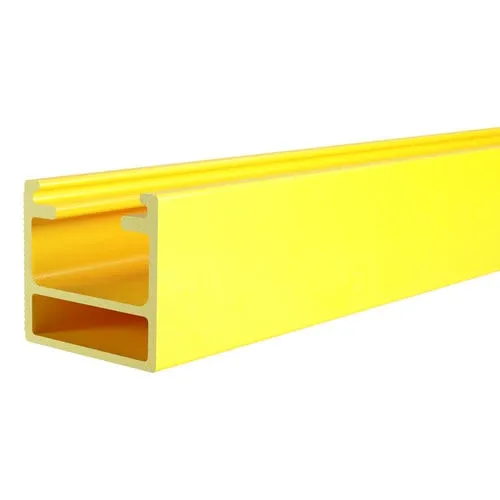
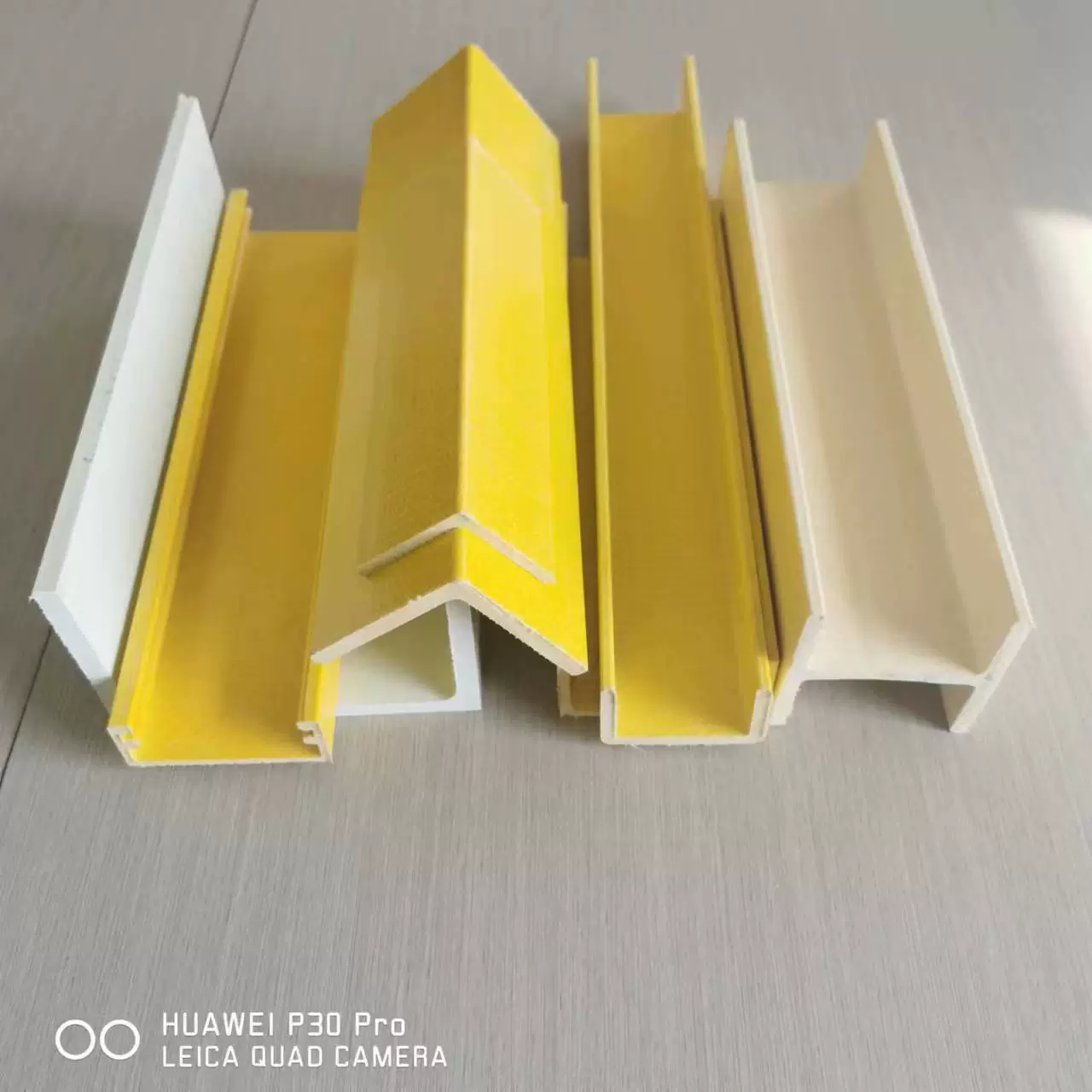
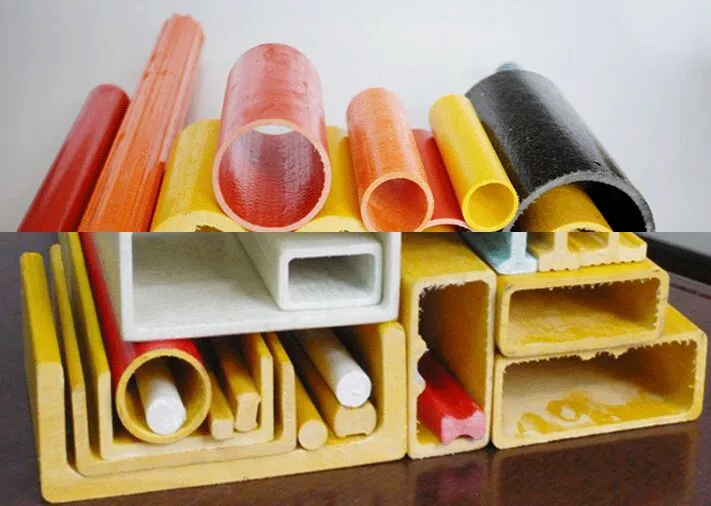
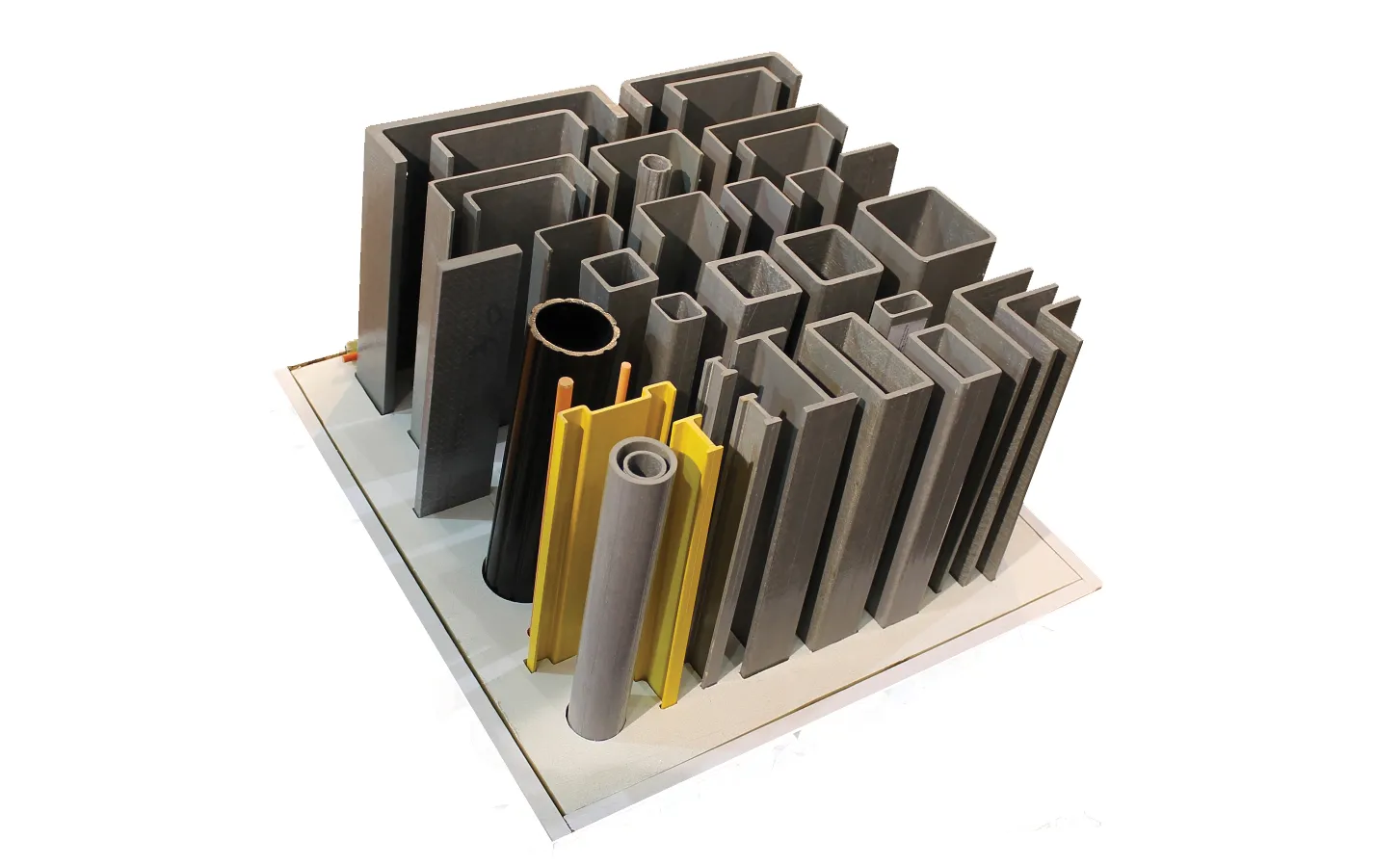
Fiberglass structural shapes — also known as FRP (Fiber-Reinforced Polymer) pultruded profiles — are composite materials made from glass fibers embedded in a thermosetting resin matrix (typically polyester, vinyl ester, or epoxy). The pultrusion process pulls continuous glass fibers through a resin bath and then through a heated die, creating constant-cross-section profiles such as:
- FRP I-beams — for main structural support in beams and columns
- FRP C channels — for framing, bracing, and edge protection
- FRP angles — for corner connections and stiffening
- FRP tubes and square profiles — for handrails, ladders, and supports
These profiles are lightweight, corrosion-resistant, non-conductive, and have a high strength-to-weight ratio. They are manufactured to standards such as EN 13706 and ASTM D3916.
What Are Steel Structural Shapes?
Steel structural shapes are hot-rolled or cold-formed from carbon steel (mild steel) or alloy steel. Common profiles include steel I-beams (wide flange, S-shapes), steel C channels (U-channels), steel angles (L-shapes), and steel hollow sections (HSS). Steel is the traditional material for construction due to its high strength, stiffness, and well-established design standards (AISC, Eurocode 3, ISO).
However, steel is heavy (7850 kg/m³ vs 1850 kg/m³ for FRP), susceptible to corrosion in harsh environments, and electrically conductive. These limitations are where FRP profiles offer compelling alternatives.
Head-to-Head Fiberglass Structural Shapes vs Steel Comparison
This section provides a detailed side-by-side fiberglass structural shapes vs steel comparison across five critical dimensions: strength, weight, corrosion resistance, cost, and lifespan.
| Property | Fiberglass (FRP) Structural Shapes | Steel Structural Shapes |
|---|---|---|
| Density | 1700 — 2100 kg/m³ | 7850 kg/m³ |
| Tensile Strength | 200 — 400 MPa (fiber orientation dependent) | 250 — 600 MPa (grade dependent) |
| Specific Strength | ~120 — 200 MPa/(g/cm³) | ~32 — 76 MPa/(g/cm³) |
| Modulus of Elasticity | 20 — 40 GPa | 200 GPa |
| Corrosion Resistance | Excellent — inherent, no coating required | Poor — requires galvanizing or paint |
| Electrical Conductivity | Non-conductive | Conductive |
| Thermal Conductivity | Low (0.3 — 0.5 W/m·K) | High (50 W/m·K) |
| Typical Lifespan | 25 — 50+ years (with UV protection) | 15 — 30 years (before corrosion requires replacement) |
| Initial Cost (material) | 2-4x steel per unit volume | Baseline |
| Lifecycle Cost | Lower — minimal maintenance | Higher — frequent repainting and repairs |
| Weight (per meter, I-beam 100mm) | ~2.5 kg/m | ~10.5 kg/m |
| Fire Performance | Self-extinguishing (fire-retardant grades available) | Non-combustible (weakens above 500°C) |
This comparison table shows that the choice depends heavily on application requirements. For projects where weight savings and corrosion resistance are priorities, FRP is often the superior choice. For high-temperature or ultra-high stiffness applications, steel may still be preferred.
Is Fiberglass Stronger Than Steel for Structural Applications?
One of the most common questions in any material comparison is: Is FRP stronger than steel? The answer depends on how you define strength.
Tensile Strength
In terms of absolute tensile strength, structural steel grades (ASTM A36 at 400 MPa, A992 at 450 MPa) typically match or exceed standard FRP profiles (200-400 MPa). However, high-performance FRP with advanced fiber architectures can achieve tensile strengths exceeding 500 MPa - comparable to many structural steel grades.
Strength-to-Weight Ratio
This is where FRP clearly outperforms steel. Because FRP is about 75-80% lighter than steel, its specific strength (strength per unit weight) is 2-4 times higher than steel. For applications where weight is a primary concern - rooftop solar mounting, marine structures, or elevated walkways - FRP provides the structural capacity of steel at a fraction of the weight.
Stiffness (Modulus of Elasticity)
Steel has a modulus of elasticity of about 200 GPa, which is 5-10 times higher than FRP (20-40 GPa). This means steel is much stiffer - it deflects less under load. For applications where deflection is the limiting factor (e.g., long-span beams), steel or larger FRP sections may be necessary. Designers often compensate for FRP lower stiffness by using deeper sections or sandwich constructions.
Is FRP Stronger Than Steel for Solar Mounting Structures?
For solar mounting specifically, FRP is often the better choice despite its lower absolute stiffness. Solar panel loads are relatively moderate, and the weight savings of FRP reduce the load on the underlying roof structure. FRP profiles excel in this application due to corrosion resistance, weight, and ease of installation - even though steel has higher absolute strength.
Weight Differences: Fiberglass vs Steel Structural Shapes
The weight differences between fiberglass and steel structural shapes are dramatic. FRP structural shapes weigh approximately 75-80% less than equivalent steel profiles, which has profound implications for installation, transportation, and structural design.
Quantitative Weight Comparison
| Profile Type | FRP Weight (kg/m) | Steel Weight (kg/m) | Weight Savings |
|---|---|---|---|
| I-Beam 100 x 50 mm | 2.5 | 10.5 | 76% |
| C Channel 100 x 50 mm | 2.1 | 8.9 | 76% |
| Angle 50 x 50 x 5 mm | 0.9 | 3.8 | 76% |
| Square Tube 50 x 50 x 3 mm | 1.2 | 4.5 | 73% |
Why Weight Matters in the FRP vs Steel Decision
- Easier installation: FRP profiles can often be installed by hand or with lighter lifting equipment, reducing crane costs and labor requirements.
- Reduced transportation costs: More material can be shipped per truckload, and lighter loads reduce fuel consumption.
- Lower foundation requirements: Lighter structures impose less dead load on foundations, potentially reducing concrete and excavation costs.
- Rooftop applications: Many roofs cannot support the dead load of steel structures without expensive reinforcement - FRP solves this.
- Marine and offshore: Every kilogram saved on offshore platforms translates to significant cost savings in buoyancy and flotation.
These weight advantages often make FRP the clear winner when evaluated from a logistics and installation perspective.
Cost Comparison: Is FRP Cheaper Than Steel?
Is FRP cheaper than steel? This is one of the most frequently asked questions when evaluating structural materials. The answer depends on whether you look at initial material cost or total lifecycle cost.
Initial Material Cost
On a per-kilogram basis, FRP pultruded profiles typically cost 2-4 times more than steel. However, this comparison is misleading because FRP is 75-80% lighter. On a per-meter or per-installed-project basis, the cost difference narrows significantly:
- Steel I-beam (100 mm): $15-25 per meter
- FRP I-beam (equivalent 100 mm): $30-60 per meter
While FRP appears more expensive upfront, several factors reduce the gap: FRP requires no corrosion protection (no galvanizing, painting, or coating), lighter weight means lower shipping costs, and less lifting equipment is needed during installation.
Lifecycle Cost: The Real Picture
When comparing how the cost of fiberglass structural shapes compares to steel over the full project lifecycle, FRP often emerges as the more economical choice:
| Cost Factor | FRP Structural Shapes | Steel Structural Shapes |
|---|---|---|
| Material cost | Higher (2-4x per kg) | Baseline |
| Transportation | Lower (lighter) | Higher |
| Installation labor | Lower (easier to handle) | Higher (needs cranes) |
| Corrosion protection (initial) | None needed | Galvanizing or painting: 10-20% of material cost |
| Maintenance (yearly) | Negligible | Repainting every 5-10 years |
| Replacement cost | Rare (25-50 year lifespan) | Frequent in corrosive environments |
| Total 30-year cost | Lower in corrosive environments | Lower in benign indoor environments |
For projects in corrosive environments (coastal, chemical, wastewater, marine), the lifecycle cost analysis clearly favors FRP despite the higher initial material investment.
FRP vs Steel for Solar Panel Mounting Applications
Solar panel mounting is one of the fastest-growing applications for FRP profiles, making the FRP vs steel for solar panel mounting comparison increasingly relevant.
What Is the Difference Between FRP Profiles and Steel for Solar Panel Mounting?
The primary differences come down to corrosion resistance, weight, electrical properties, and installation complexity:
- Corrosion: Steel mounting structures require hot-dip galvanizing or specialized coatings to prevent rust, especially in coastal or agricultural environments. FRP is inherently corrosion-resistant and needs no protective coating.
- Weight: FRP profiles are 75% lighter than steel, reducing roof loading and making installation safer - critical for rooftop solar arrays where structural capacity is limited.
- Electrical properties: FRP is non-conductive, eliminating the need for grounding of mounting structures and reducing galvanic corrosion risks.
Why Choose FRP Over Steel for Solar Panel Mounting?
- Zero corrosion in harsh environments - coastal, industrial, and agricultural sites benefit enormously
- Lightweight profiles reduce roof structural reinforcement costs
- Non-conductive material enhances electrical safety and simplifies grounding requirements
- Lower thermal conductivity reduces thermal bridging compared to steel
- Faster installation with smaller crews and no welding required
How Long Do FRP Profiles Last Compared to Steel in Outdoor Solar Applications?
In outdoor solar environments, FRP profiles typically last 25-50 years with UV-resistant resin formulations. Steel in the same environment, even with galvanizing, typically requires maintenance after 10-15 years and may need replacement within 20-30 years.
Which Is Better for Solar Mounting: FRP Profiles or Steel?
For most solar mounting applications - particularly rooftop, coastal, and agricultural installations - FRP profiles are the better choice due to corrosion resistance, weight, and lifecycle cost advantages. Steel may still be preferred for large ground-mount utility-scale solar farms in benign environments where initial cost is the primary driver.
FRP C Channel vs Steel and FRP I Beam vs Steel I Beam
When comparing specific product profiles, the FRP C Channel vs Steel comparison and FRP I Beam vs steel I Beam comparisons help engineers make informed decisions at the component level.
FRP C Channel vs Steel
C channels (U-channels) are widely used for framing, edge protection, cable trays, and structural bracing. Here is how they compare:
| Property | FRP C Channel (100x50x5mm) | Steel C Channel (100x50x5mm) |
|---|---|---|
| Weight per meter | ~2.1 kg/m | ~8.9 kg/m |
| Tensile strength | 300 MPa (longitudinal) | 400 MPa |
| Modulus of elasticity | 25 GPa | 200 GPa |
| Corrosion resistance | Excellent (inherent) | Poor (requires coating) |
| Typical applications | Cable trays, walkways, chemical plant framing | Building frames, heavy bracing |
FRP I Beam vs Steel I Beam
I-beams are the backbone of structural framing. In the FRP I Beam vs steel I Beam comparison:
| Property | FRP I Beam (100x50mm) | Steel I Beam (100x50mm) |
|---|---|---|
| Weight per meter | ~2.5 kg/m | ~10.5 kg/m |
| Section modulus (Wxx) | ~40 cm³ | ~46 cm³ |
| Load capacity (simple span 3m) | Moderate (deflection-limited) | High |
| Typical applications | Walkways, platforms, mezzanines | Building columns, bridge girders |
The FRP C Channel vs Steel comparison and FRP I Beam vs steel I Beam comparison show that while FRP has lower load capacity for equivalent section sizes, its light weight allows for easier handling and installation. FRP beams and channels are commonly used in pedestrian walkways, chemical plant platforms, and mezzanines where corrosion resistance is critical. Steel remains the standard for heavy structural applications where deflection limits are the primary concern.
When Should You Use Fiberglass Structural Shapes Instead of Steel?
Deciding when to use fiberglass structural shapes instead of steel depends on several application-specific factors.
Corrosive Environments
If your project is in a coastal area, chemical plant, wastewater treatment facility, or agricultural setting with ammonia exposure, FRP is the clear winner. Steel requires expensive corrosion protection systems (galvanizing, epoxy coatings, stainless steel), and even these eventually fail. FRP will outlast steel in these environments by decades with zero maintenance.
Weight-Sensitive Applications
For rooftop installations, elevated walkways, platforms on existing structures, or any application where dead load is a concern, FRP profiles are preferred. Their 75% weight reduction compared to steel can eliminate the need for structural reinforcement.
Electrical Safety Requirements
In electrical substations, telecommunications facilities, and areas where electrical conductivity poses a safety risk, FRP non-conductive properties make it the safer choice. Steel requires grounding and isolation measures that add cost.
When to Use Steel Instead
Steel remains the better choice when:
- Ultra-high stiffness is required (long-span beams with tight deflection limits)
- Fire-rated structures need non-combustible materials (though fire-retardant FRP is available)
- Initial material cost is the only budget consideration (indoor, non-corrosive environments)
- Welded connections are preferred over bolted or adhesive joints
- Extreme temperatures (above 200°C continuous) are present
This comparison is not about one material being universally better - it is about selecting the right material for the specific application requirements.
Can Fiberglass Replace Steel in Load-Bearing Applications?
The question of whether fiberglass can replace steel in load-bearing applications is nuanced. The short answer is: yes, in many applications - but with careful engineering consideration.
Applications Where FRP Can Replace Steel
FRP structural shapes have successfully replaced steel in numerous load-bearing applications:
- Pedestrian walkways and bridge decks: FRP grating and I-beams are widely used for pedestrian bridges with spans up to 20 meters.
- Platforms and mezzanines: In chemical plants and industrial facilities, FRP structures support heavy equipment loads.
- Solar mounting structures: FRP supports the full weight of solar panels, including wind and snow loads.
- Cooling tower structures: FRP replaces steel entirely in cooling towers where humidity and chemicals corrode steel rapidly.
- Marine piers and docks: FRP piling and structural shapes support substantial loads in saltwater environments.
- Railings and handrails: FRP structural shapes meet OSHA and IBC load requirements for safety barriers.
Limitations of FRP in Load-Bearing Applications
There are situations where steel remains necessary:
- Primary building frames: For multi-story building columns and main beams, steel higher stiffness is typically required.
- High-temperature applications: FRP mechanical properties degrade above 200°C; steel maintains strength at higher temperatures.
- Impact loading: Steel is more ductile and absorbs impact energy better than FRP, which is more brittle.
- Crane rails and heavy machinery supports: Dynamic loads and wear resistance favor steel.
Engineering Considerations for FRP in Load-Bearing Roles
- Creep behavior: FRP can creep under sustained load, requiring higher safety factors.
- Connection design: Bolted connections should use oversized holes and stainless steel fasteners.
- UV protection: For outdoor applications, UV-resistant resin or paint topcoats are needed.
- Fire performance: Fire-retardant FRP grades achieve Class 1 or Class A flame spread ratings.
FRP is a viable structural material when properly engineered for the specific application requirements.
Conclusion
This comprehensive fiberglass structural shapes vs steel comparison demonstrates that both materials have their place in modern construction and industrial applications. The key takeaways are:
- Strength: Steel has higher absolute strength and stiffness, but FRP offers superior strength-to-weight ratio - ideal for weight-sensitive applications.
- Weight: FRP is 75-80% lighter than steel, reducing installation costs, transportation expenses, and foundation requirements.
- Corrosion resistance: FRP inherently resists corrosion, while steel requires expensive protective coatings and maintenance.
- Cost: While FRP has higher initial material costs, its lifecycle cost is often lower in corrosive environments due to minimal maintenance.
- Lifespan: FRP profiles last 25-50+ years in outdoor environments, compared to 15-30 years for steel before significant corrosion-related maintenance is needed.
- Load-bearing: FRP can effectively replace steel in many structural applications when engineered correctly, particularly in corrosive or weight-sensitive environments.
For solar panel mounting, chemical plant platforms, marine structures, and wastewater facilities, FRP structural shapes are increasingly the material of choice. For heavy industrial framing, high-temperature applications, and situations where every millimeter of deflection matters, steel remains the benchmark.
When evaluating your next project, consider not just the material cost but the total installed cost, maintenance requirements, and expected service life. In many cases, FRP delivers superior long-term value and performance.
Contact our team to discuss your specific application requirements and get expert guidance on selecting the right structural material for your project.